
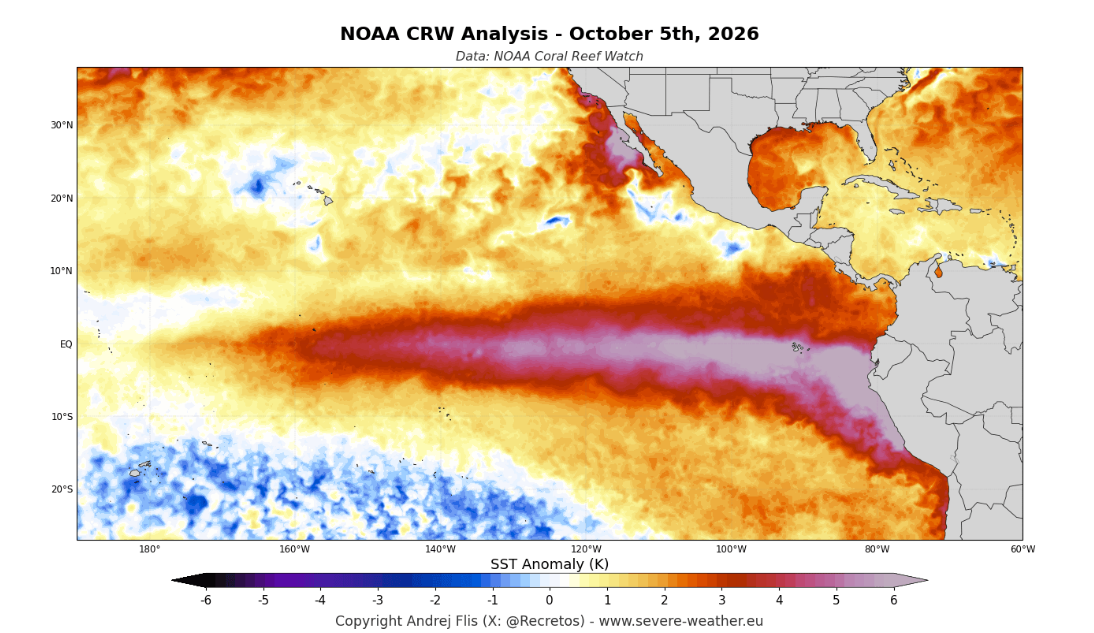
Forecasted Super El Niño Drives 4°C Sea Surface Surge
Droughts, floods, wildfires. 2026 challenged us in many ways, and it still does. We have not even had the chance to recover; now “El Niño”, the strongest on record, is expected to shift weather patterns, peaking from December to February 2027.
“It changes the current, it changes the winds, it changes a lot of things, so the fisherman has to go further out,” said Eusebio Rodriguez, a fisherman on Panama's Pacific coast. (WION News). He highlighted the massive decline in fish yields, which drives up prices in the fish market. Although El Niño has not yet reached its peak, it is affecting fishing.
It triggered a major crisis along Latin America’s Pacific coast. A crucial fish stock, like tuna and anchovies, is forced to seek deeper and cooler waters. Small-scale fishermen, like Eusebio Rodriguez, pull half-empty nets or they decide to stay docked entirely. As Rodriguez bluntly put it: they are giving up their life's work to "seek jobs in construction."
The Seafood Alliance, headquartered in Belgium, warns that "any decline in biomass or in catch quotas would tighten the global supply of fishmeal and fish oil"—which, in turn, "increases feed costs for those aquaculture sectors that dominate imports into the United Kingdom and the EU.” Seafood Alliance explains global seafood supply chains are likely to face significant risk in 2026-2027 as prices spike by 20-40%, similar to the last strong El Niño event.
But the El Niño influence does not stop there.
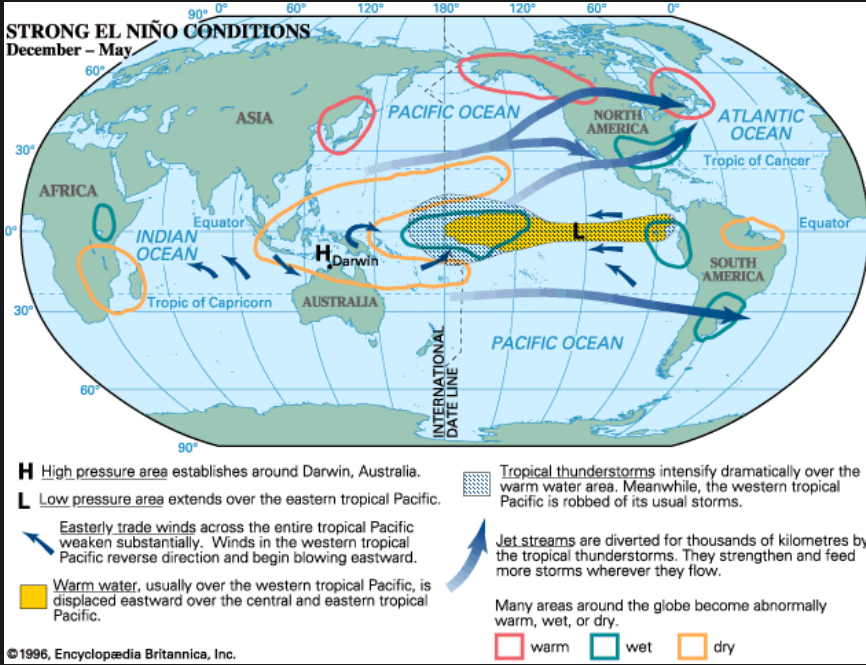
During typical conditions, the Pacific trade winds move east-west, carrying warm surface water to Asia. During El Niño, the opposite is true. As the winds weaken, a massive pool of warm water shifts toward South America. The warm ocean environment affects the Pacific jet stream's position as well as worldwide weather and climate trends. The southern United States, sections of South America, and East Africa see record rainfall and flooding; in contrast, Australia, Indonesia, and parts of southern Asia suffer severe droughts as a result of suppressed monsoon and reduced Atlantic storm activity.
To truly understand the consequences of El Niño, one must peer at the human cost. We look back on the previous major El Niño cycle in 2023 to Victor, a resident of Homa Bay, Kenya, who witnessed this destruction firsthand. He sent pictures during the floods to my phone from his region that showed swelling rivers turning dirty, with tons of material washing away, everything on its way, destroying infrastructure, buildings, schools, and agricultural fields and parks. Considering only Kenya's experience with El Niño 2023, at least 245 people have died, 78,683 households were affected, and 45,778 households were displaced.
Blizzards, Ice Storms, Snow. Parts of North America are facing heavy winter activity; as a comparison of how hard a strong El Niño can hit, it showed the winter storm “Jonas” in 2015.
Jim Murdoch, a freelancer at News 12 at this time as storm “Jonas” hit, said: “ The storm started to really get cranking. And then we expected the high tide, I believe, once daybreak. A couple hours after the sun came up, we saw everything from thunder and lightning in the snow on live TV to probably a 3 to 4 ft storm surge with icebergs floating down Brielle Road.
This storm, “Jonas,” back in 2015 was a historic and deadly blizzard that paralyzed the Mid-Atlantic and Northeastern United States, causing an estimated $500 million to $3 billion in economic losses and around 48 to 55 fatalities.
The combination of subfreezing Arctic and Canadian air colliding with high humidity and warm moisture from the Gulf of Stram/Atlantic, all supercharged by a strong El Niño jet stream and rapid central pressure drop, may happen again near the end of the year 2026, according to experts.
The pretty obvious conclusion is that we should buckle up
El Niño is a periodic phenomenon. Policymakers can plan ahead of time and use forecasts to take necessary safeguards. El Niño is characterized by a spike in sea-surface temperature, which is continuously monitored.
Whether this “super” El Niño will translate into global super-damage, Chris Funk, a climatologist at the University of California, offered a blunt warning to Science: “The pretty obvious conclusion is that we should buckle up.”
0 Comments Add a Comment?